ISBN: 9781041093077 (Hardback)
ISBN: 9781041093084 (Paperback)
37 chapters, 11 appendices, 70 figures, extensive references, and a comprehensive index, in 204 pages.
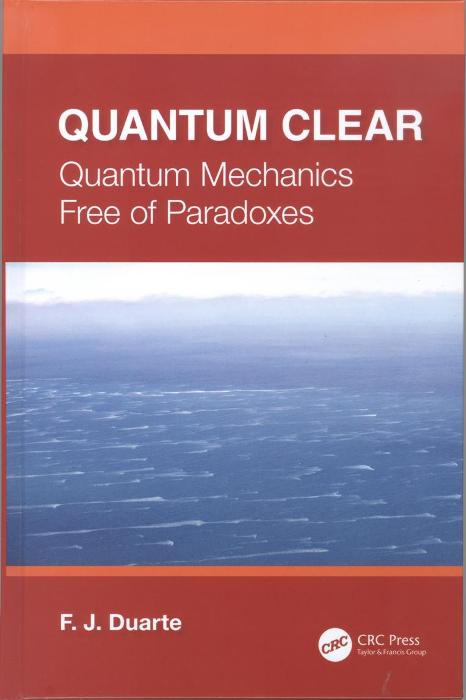
Quantum mechanics is the most fundamental, and most successful, branch of physics. It was discovered from the experiment and forged with the experiment. And yet, given its unique indeterministic perspective of Nature, it is also the most criticized branch of physics. Famous critics, such as Einstein, and Schrödinger, called it ‘not complete’ and even ‘repugnant’, respectively. On the other hand, for those of us who have been in contact with quantum mechanics for nearly 50 years, and made a living out of it for the last 45 plus years, quantum is like a benevolent teacher and generous provider that is misunderstood by many and unappreciated by others. The ineffability of quantum mechanics is a direct consequence of quantum mechanics’s proximity to Nature. Indeed, Nature is a lot more subtle, a lot more richer, than what our linguistic abilities can describe and our philosophies can assimilate. In Quantum Clear we set out to explain the foundations of quantum mechanics and to clarify many of the misunderstandings that surround it.
1.1 INTRODUCTION
1.2 THE HISTORY OF QUANTUM ENTANGLEMENT
1.2.1 The Physical Path to Quantum Entanglement
1.2.2 The Philosophical Path to Quantum Entanglement
1.3 QUANTUM ENTANGLEMENT'S MAIN CREATIONS
1.4 MAIN QUANTUM SOURCES
1.5 QUANTUM CLEAR
1.6 TERMINOLOGY
1.7 INTENT
ACKNOWLEDGEMENTS
REFERENCES
Abstract
What is physics? This is such a basic question that many physicists don’t even think about it. On the other hand, to the general public, physics might come across as something difficult to understand, useful, and yet, even dangerous. In this brief essay our original intent was to answer the question for the physicists since it appears that some have lost sight of the original meaning of the word physics. The word physics in the English language goes back to physica in Latin which means something like the study of Nature. And certainly, the Latin version originally comes from the Greek that of course also bases its meaning in Nature. And this is the crux of the matter: physics is the study of Nature and as such the central theme of our essay is that the only avenue to Nature is the experiment and therefore… the experiment is the ethos of physics.
2.1 Introduction
2.2 Physics
References
Abstract
The quantumness of quantum mechanics is integrated by those properties and characteristics so unique to quantum mechanics that makes it an utterly extraordinary, and fascinating, branch of physics. And the beauty of it, is that this quantumness has its origin in the very foundations of quantum physics built on experimental facts and thus they reflect the character of Nature itself. Indeterminacy, indistinguishability, nonlocality, uncertainty, and superposition are not the byproducts of some strange unverified theory but they are the characteristics of a brave experimentally based physics that has been verified by experiment time and time again. Add to this that most of the action in quantum physics takes place via probability amplitudes, that exist in a purely mathematical realm, and you have something superbly unique. Those are the elements that configure the quantumness of quantum mechanics, as discussed and described in this chapter.
3.1 INTRODUCTION
3.2 QUANTUM CHARACTERISTICS
3.2.1 Indeterminacy
3.2.2 Quantum Interference: Probability Amplitudes
3.2.3 Heisenberg’s Uncertainty Principle
3.2.4 The Nonlocality of The Photon
3.2.5 Superposition
3.2.6 Quantum Entanglement
3.2.7 Born’s Rule
3.2.8 Indistinguishablity
3.2.9 Duality
3.2.10 Noncommutability
3.2.11 Quantum Operators
3.2.12 Macroscopic Quantum Tunneling
3.3 CONCLUSION
REFERENCES
Abstract
Quantum mechanics runs on probability amplitudes. Probability amplitudes must accurately describe the physics prior to calculating the quantum probability. Symbolical probability amplitudes are mathematically represented by complex wave functions. Many physicists in the field don’t even mention the words probability amplitude and prefer to refer to wave function, or state, instead. When they do that they miss out on the subtleties of the physics at hand. In this brief chapter we emphasize probability amplitudes à la Dirac since that is the way Feynman and Ward preferred to describe quantum mechanics. The Dirac notation is also ideally suited to describe quantum interference and quantum entanglement.
4.1 INTRODUCTION
4.2 DIRAC'S NOTATION
4.3 WAVE FUNCTIONS AND VECTORS
4.4 CONCLUSION
REFERENCES
Abstract
Quantum interference, which is a physical phenomenon, and probability amplitudes à la Dirac are miraculously like synonyms. Indeed, the way probability amplitudes are written down on paper is very much as a single photon, or an ensemble of indistinguishable photons, propagates from one plane to the next. And then, if at one of the planes an N-slit array alternative is offered then the probability amplitude notation à la Dirac cleverly describes the N-path alternative via a mathematical summation. Here we should emphasize that since the photon is a nonlocal quantum entity, all the microscopic slits in the N-slit array, or transmission diffraction grating, are illuminated simultaneously.
5.1 INTRUDUCTION
5.2 FIRST LAYER OF QUANTUM MECHANICS
5.3 CONCLUSION
REFERENCES
Abstract
In quantum mechanics, the physics of probability amplitudes, that exists in the imaginary and complex mathematical realm, is brought to the measurable realm by the iconic Born rule that converts the superposition probability amplitude into a measurable interferometric probability distribution. When Born first introduced his rule, in 1926, he did so in the absence of a physical derivation. In fact, Born never offered a derivation for his most crucial rule. In this chapter a transparent interferometric derivation of Born’s rule is given. Furthermore, it is indicated that far from a ‘collapse’ the transition, for interferometric configurations, clearly involves a mathematical expansion. The transition for quantum entanglement is also discussed.
6.1 INTRODUCTION
6.2 BORN'S RULE FROM QUANTUM OPTICS
6.3 QUANTUM PROBABILITIES
6.4 INTERFEROMETRIC QUANTUM PROBABILITIES
6.5 THE EFFECT OF AN INTRAINTERFEROMETRIC OBSERVER Effect
6.6 CONCLUSION
REFERENCES
Abstract
Heisenberg’s uncertainty principle is one of the unique and iconic features of quantum mechanics that distinctly separates this physics, based on indeterminacy, from any and all classical deterministic theories. Besides its succinct utter beauty, as articulated by Feynman, ‘it protects quantum mechanics.’ In addition to its foundational importance and ‘protection’ function, the uncertainty principle plays crucial experimental roles in the measurement of coherent emission linewidth and in determining the nonlocality of the photon via measurements of coherence length. Physically, it can be shown that it has its origin in the physics of measurable interferometric quantum probability distributions. This insight teaches us that, unlike probability amplitudes, firmly resides in the measurable realm.
7.1 INTRODUCTION
7.2 THE INTERFEROMETRIC ORIGIN OF THE UNCERTAINTY PRINCIPLE
7.3 CONCLUSION
REFERENCES
Abstract
Quantum interference and quantum entanglement are intrinsically ‘entangled’ at the most fundamental strata of quantum mechanics. In fact, John Clive Ward defined the whole of quantum mechanics in the following terms: ‘the probability amplitude of quantum entanglement… was my first lesson in quantum mechanics, and in a very real sense my last, since all the rest is mere technique, which can be learnt from books.’ Albeit Ward’s opinion is somewhat colored by his ineffable genius, there is no doubt that quantum entanglement is at the foundations of quantum mechanics. Quantum entanglement encapsulates indeterminacy, superposition, and nonlocality with sublime cohesiveness. In this chapter we describe the fine details of the physics of quantum entanglement, free of paradoxes, its interferometric origin, and its generalized character.
8.1 INTRODUCTION
8.2 THE DIRAC-WHEELER-PRYCE-WARD PATH
8.3 THE INTERFEROMETRIC DERIVATION OF QUANTUM ENTANGLEMENT
8.4 GENERALIZED QUANTUM ENTANGLEMENT
8.5 CONCLUSION
REFERENCES
Abstract
Ever since Schrödinger envisioned the possibility of quantum entanglement, in 1935, by contemplating the implications of the meaning of ‘not complete’ emitted by Einstein and colleagues towards quantum mechanics… the word paradox has been brought forth. Paradox was again invoked by Bohm in the 1950s and of course the creation of Bell’s theorem was motivated by it. Paradox has been a trademark of the philosophical path towards quantum entanglement. And yet, the physics tells us that quantum entanglement is not afflicted at all by any paradox whatsoever. That this was the case was first silently implied by the physics of Dirac, Wheeler, and Pryce and Ward (1930-1947) and directly articulated by Feynman in 1965. Here we transparently show that, from the quantum interference perspective, the physics of quantum entanglement is completely and utterly free of paradoxes.
9.1 INTRODUCTION
9.2 FROM QUANTUM INTERFERENCE TO QUANTUM ENTANGLEMENT
9.3 CONCLUSION
REFERENCES
Abstract
Quantum mechanics is based on the concepts of indeterminacy, indistinguishability, probability amplitudes, probabilities, reversibility, superposition, and uncertainty. And yet that is only part of the essence of quantum mechanics. Using the words attached to the concepts just described, provides only a partial description of what quantum mechanics really is. The other part is provided by a set of physical and mathematical principles annexed to the mentioned concepts. The beauty is that quantum mechanics becomes workable and functional just by observing its mathematical principles. There is no need for any particular interpretation. Not even the orthodox interpretation. Here, fifteen mathematical-physical principles of quantum mechanics are listed and succinctly explained.
10.1 INTRODUCTION
10.2 THE PRINCIPLES OF QUANTUM MECHANICS
10.3 CONCLUSION
REFERENCES
Abstract
The Schrödinger equation is a beautiful wave equation that leads us directly to the widely used Hamiltonians in quantum mechanics. The Schrödinger equation was also there at the very beginning of quantum mechanics. Therefore it should not be surprising that when most people refer to quantum mechanics they do so from the vantage point of the Schrödinger equation. However, there are also several other versions of quantum mechanics. Most notable is the version of quantum mechanics introduced by Heisenberg that was transformed into a matrix formalism via a collaborative effort of Born, Heisenberg, and Jordan. Then around came our favorite, Dirac’s bra ket notation. Dirac also inspired Feynman to introduce his path integrals. But there are also others. A brief description follows.
11.1 INTRODUCTION
11.2 SIX VERSIONS OF QUANTUM MECHANICS
11.3 CONCLUSIONS
REFERNCES
Abstract
Quantum mechanics values highly its sovereignty and does not allow extraneous intrusions. In quantum mechanics processing we can only observe the input state and the output state. Attempts to intrude, or to ‘peek in between,’ are always successfully detected. This is the essence behind quantum cryptography and the principle of what provides robust security to quantum communications in general. Here we focus on quantum entanglement based cryptography. This methodology puts to work Bell’s theorem to verify that no external intrusion has occurred. We also describe a more stringent all-quantum protocol entirely based on a measurements strategy. The chapter concludes with a description of the N-slit interferometric communications approach that reinforces understanding of the concepts that bring unprecedented security to quantum communications.
12.1 INTRODUCTION
12.2 QUANTUM ENTANGLEMENT COMMUNICATIONS
12.2.1 All-Quantum Protocol
12.3 INTERFEROMETRIC COMMUNICATIONS
12.4 CONCLUSION
REFERENCES
Abstract
Quantum teleportation, because of the word teleportation, may seem to bring us to the edge of science fiction. But not so fast. Quantum teleportation refers to the use of a quantum entanglement apparatus with its entangled photon pair source, its two detection stages, plus additional necessary optics, to transport a quantum state from one site to another site. This is done via the use of quantum entanglement probability amplitudes and with the help of a classical transmission of a unitary transformation. A unitary transformation is a mathematical matrix that takes the form of the Pauli matrices or the identity matrix.
13.1 INTRODUCTION
13.2 QUANTUM TELEPORTATION
13.3 CONCLUSION
REFERENCES
Abstract
Matrices are widely, and extensively, used in quantum mechanics. Indeed, one of the avenues to quantum mechanics, that of Born, Heisenberg, and Jordan, is via matrices. One additional asset of matrices is that they are the natural mathematical language to describe quantum computing. Furthermore, matrices identify themselves in the physical tangible world via optical elements such as mirrors, beam splitters, polarization rotators, and interferometers. And these are the elements that comprise the hardware of photonic quantum computers. Here, we introduce the Pauli matrices plus the identity matrix, via the probability amplitudes of quantum entanglement. Once this is accomplished, we show how these matrices can be used to perform mathematical transformations, on quantum entanglement states, that form the bases of quantum computing as treated in the next chapter.
14.1 INTRODUCTION
14.2 PROBABILITY AMPLITUDES IN VECTOR NOTATION
14.3 PAULI MATRICES
14.4 PAULI MATRICES AND QUANTUM ENTANGLEMENT
14.5 QUANTUM ROTATIONS
14.6 THE HADAMARD MATRIX
14.7 CONCLUSION
REFERENCES
Abstract
All computers are quantum computers but some are more quantum than others. Universal classical computers rely on the transistor, a quantum semiconductor, for their operation but use simple binary digital logic based on bits, 1 and 0. Quantum computers, those we are interested in here, utilize the qbits |1> and |0> , which are quantum states, to realize their quantum logic. These qbits are used in conjunction with superposition probability amplitudes to interact with optical components such as beam splitters, interferometers, and polarization rotators to perform quantum logical operations. In this chapter, a basic description of quantum logic, and quantum optical configurations, utilized in workable quantum computers is given.
15.1 INTRODUCTION
15.2 BRIEF HISTORY
15.3 THE LANGUAGE OF QUANTUM COMPUTING
15.4 BASIC PAULI GATE OPERATIONS
15.5 QUANTUM COMPUTING AND QUANTUM OPTICS
15.6 THE HADAMARD MATRIX AND BEAM SPLITTERS
15.7 INTEGRATING A QUANTUM COMPUTER
15.8 CHALLENGES
REFERENCES
Abstract
As openly stated by Willis Lamb, the field of quantum measurements has not been helped by the ample participation of theorists in it (although Lamb himself has been described as a theorist turned experimentalist). The point is, as validly exposed by Lamb, that when it comes to quantum measurements there is a plethora of misunderstandings that mystify and confuse those who describe them and those who listen. Here, the so called ‘measurement problem’ comes to mind. The very first concept in explaining what is a measurement, and not just a quantum measurement, is that no measurement is exact. In physics no one can measure x exactly. When we measure x we always measure it as x plus or minus the measurement uncertainty. This observation alone immediately brings in stochasticity into the measurement arena. In measurements there is no escape from stochasticity. In this chapter the measurement process is described from an interferometric perspective.
16.1 INTRODUCTION
16.2 THE QUANTUM INTERFERENCE MEASUREMENT he Quantum Interference Measurement
16.2.1 The Interferometric Quantum Probability
16.2.2 Single-Photon Interferometric Measurement
16.2.3 Interferometric Measurements Via Ensembles of Indistinguishable Photons
16.3 CONCLUSION
REFERENCES
Abstract
Born was convinced that the ‘indeterministic foundations’ of quantum mechanics were here to stay. He also left a calling, that has been largely ignored, to show that the ‘apparently deterministic’ laws of classical physics were derivable from the indeterminacy of quantum mechanics. Here, we attempt to answer the calling left to us by Born and we do so first by showing that the beautiful laws of classical optics are directly derivable from the N-slit quantum probability equation. Secondly, we use the quantum probability dependent intensity to arrive, via Heisenberg’s uncertainty principle, first at Newton’s second law and then to Newton’s law of universal gravitational. What this shows is that there is an explicit cohesiveness in physics with quantum mechanics at the foundations. The only ‘price to pay’ is that the laws of classical physics become approximate rather than ‘exact.’ No more determinism. This is entirely consistent with the fields of experimental physics, quantum or classical, where no measurement is exact.
17.1 INTRODUCTION
17.2 CLASSICAL OPTICS FROM QUANTUM OPTICS
17.3 QUANTUM INTERFERENCE AND CLASSICAL INTERFERENCE
17.4 NEWTON'S SECONND LAW FROM CLASSICAL INTERFERENCE
17.5 CONCLUSION
REFERENCES
Abstract
The quantum-classical boundary remains a frontier of research and discovery. One area of attention revolves around Planck’s constant, h, a very small number indeed. In reference to the value of h, Feynman said that if h goes to 0: ‘the classical and quantum results would be the same, and there would be no quantum mechanics to learn!’ This certainly highlights the subtlety of quantum mechanics. Recently, small progress has been made in this field by using Heisenberg’s uncertainty principle to successfully transition from quantum mechanics to classical mechanics and derive Newton’s second law . However, the real question here is… when does quantum become classical? In this chapter we suggest that, regarding conglomerates of atoms, quantum becomes classical when indistinguishability is lost. In other words, when something that was indistinguishable… becomes distinguishable. A heavy atom interferometer experiment is suggested to elucidate this most fascinating unknown.
18.1 THE QUANTUM CLASSICAL BOUNDARY
18.2 WHEN DOES QUANTUM BECOME CLASSICAL?
18.3 GRAVITY
18.4 QUANTUM INTERFERENCE AT THE BOUNDARY
18.5 EXPERIMENT
18.6 CONCLUSION
REFERENCES
Abstract
Electromagnetism and quantum mechanics share a few crucial characteristics. First of all, both, electromagnetism and quantum mechanics, separately and in unison provide the foundations for the informational civilization we now live in. Take electromagnetism away and civilization collapses. Take quantum mechanics away and civilization crumbles. The second essential feature that both these physical phenomena share is that they function via waves and fields. Thirdly, as Freeman Dyson so insightfully indicated, both electromagnetism and quantum mechanics are configured in a two layer structure. Intangible waves and fields, plus a two layer structure of understanding introduce their fourth commonality: a propensity to be misunderstood. Here, we describe how electromagnetism and quantum mechanics find a common meeting ground in the field of optics.
19.1 INTRODUCTION
19.2 MAXWELL'S EQUATIONS
19.3 MAXWELL'S EQUATIONS AND OPTICS
19.4 QUANTUM INTERFERENCE AND CLASSICAL INTERFERENCE
19.5 DYSON'S INSIGHT
19.6 CONCLUSION
REFERENCES
Abstract
We live in the measurable realm of quantum mechanics. In other words, we live in the classical realm where time is measurable and entropy is quantifiable. For us mortals, in the classical world, time is real, measurable, and inescapable. However, in the quantum world, probability amplitudes are reversible. They can be used to describe interference and quantum entanglement, or vice versa. Measurable quantum probabilities can be used to predict the future or applied to go backwards in time to observe what an interferogram was in its initial state. Interferometric quantum probabilities can be used to quantify entropy. They can describe a highly structurized interference regime, at an initial state, or the loss of structure, leading to near Gaussian uniformity, characteristic of higher entropy, at a later time. Furthermore, in this chapter, we also describe the principle of minimum entropy.
20.1 INTRODUCTION
20.2 QUANTUM TIME AND QUANTUM ENTROPY
20.3 MINIMUM ENTROPY
20.4 FORWARD AND BACKWARD IN TIME
20.5 CONCLUSION
REFERENCE
Abstract
Schrödinger’s equation is a beautiful wave equation that includes Planck’s constant h and the imaginary number i , and thus, it’s a quantum equation. However, by way of its derivation, it is a semiclassical equation that represents the most deterministic avenue towards quantum mechanics. Schrödinger’s equation is widely applied in semiconductor physics, in the description of semiconductor lasers, and in the description of atoms. However, it participates neither in the physics of quantum interference nor quantum entanglement. Here, we provide a non rigorous heuristic derivation of Schrödinger’s equation that leads to the Hamiltonian, a widely used energy term in quantum mechanics.
21.1 INTRODUCTION
21.2 HEURISTIC DERIVATION
21.3 QUANTUM APPROACH
21.4 CONCLUSION
REFERENCES
Abstract
The ‘EPR paradox’ is directly related to the 1935 paper of Einstein, Podolsky, and Rosen, even though Einstein did not include the word ‘paradox’ in it. All Einstein and his co authors did was to construct an argument that concluded that quantum mechanics was ‘not complete.’ This EPR conclusion is examined in detail here and found to be based on the erroneous assumption of an ‘all values’ spread in x that leads to an unphysical exact measurement of the momentum p. The word paradox, in relation the second part of the EPR paper, was introduced by Schrödinger in 1936 and popularized by Bohm in the 1950s. Hence, we should not attach responsibility to EPR for the ‘paradox’ situation. It was Schrödinger and Bohm who attached and propagated the term paradox in relation to the EPR paper. And the literature made it famous. This is particularly lamentable since the physics of quantum entanglement is utterly free of paradoxes.
22.1 INTRODUCTION
22.2 EPR CLAIMS CLAIMS OF INCOMPLETNESS
22.3 EPR AND THE UNCERTAINTY PRINCIPLE
22.4 EPR AND TWO SYSTEMS
22.5 CONCLUSION
REFERENCES
Abstract
Schrödinger’s equation is one of the avenues to quantum mechanics as we know it today. It is a beautiful wave equation, that albeit quantum, is associated with classical and deterministic physics. Given his background based on determinism, it is not all that surprising to observe Schrödinger, about a decade after his monumental contribution, embarking in an all out assault against the blatant indeterminacy of quantum mechanics. Schrödinger inspired his criticism towards quantum mechanics on the second part of the EPR paper. As such, he was able to glimpse at the possibility of quantum entanglement and he was immediately tormented. And the use of the word tormented is not an exaggeration since Schrödinger himself used epitaphs such as ‘discomforting,’ ‘disconcerting,’ and even ‘repugnant’ in reference to the possible occurrence of quantum entanglement.
23.1 INTRODUCTION
23.2 STEERED OF PILOTED
23.3 QUANTUM MECHANICS 'OBLIGES'
23.4 CONCLUSION
REFERENCES
Abstract
Hidden variable theories, ‘the hidden parameter’ as von Neumann called them, entered the quantum scene soon after the formalization of quantum mechanics as we know it today. That formalization was led by front-line physicists like Born, Dirac, Heisenberg, Jordan, and Schrödinger. Attention to hidden variable theories garnered strength following the criticisms towards quantum mechanics formulated by Einstein and colleagues in 1935. That criticism, stating that quantum mechanics was ‘not complete,’ as a theory, led Bohm, in the 1950s, to formulate hidden variable theories. In turn, Bell in 1964 introduced his famed Bell theorem that provided a test for the existence of hidden variable theories. This chapter examines the history of the futile search, for experimental proof, for the existence of these theories.
24.1 INTRODUCTION
24.2 BOHM'S HIDDEN VARIABLE THEORIES
24.3 THE BOHM AND AHARONOV PAPER
24.4 THE EPR-BOHM INFLUENCE
24.5 CONCLUSION
REFERENCE
Abstract
Hidden variable theories, as encouraged by the EPR paper, that proliferated in the 1950s, were taken quite seriously in some academic quarters, despite the existence of the 1932 von Neumann ‘proof’ that supposedly showed that these hidden theories were incompatible with the stochasticity of quantum mechanics. In 1964, John Bell, a particle theorist, reexamined the von Neumann proof, found it ‘wanting’, and offered his own proof that reaffirmed that hidden variable theories were incompatible with quantum mechanics. Bell added a twist: his proof was in the form of a neat inequality theorem that was easy to comprehend and became an instant success. Bell’s theorem led to a new generation of experimentalists to rediscover quantum entanglement, and to conduct these experiments in the visible spectrum, to test for evidence of hidden variable theories. The results were negative thus reaffirming the validity of quantum mechanics and its indeterminacy. In this chapter the premises of Bell’s theorem are explained as well as its link to the probabilities of quantum entanglement.
25.1 INTRODUCTION
25.2 INFLUENTIAL REFERENCES
25.3 BELL'S THEOREM
25.4 CONCLUSION
REFERENCES
Abstract
‘The collapse of the wave function’ was first introduced as an explanatory concept by Heisenberg. Then it was ‘formalized’ by von Neumann, in his book Mathematical Foundations of Quantum Mechanics. Essentially, this concept says that at the moment of measurement the superposition probability amplitude collapses to a single quantum state. In quantum interference and quantum entanglement, it is found that this hypothetical reduction to a single quantum state is an unnecessary intermediate step that provides no further information to the experimentalist. Indeed, in quantum interference the measurement sequence goes from superposition probability amplitude to multiplication of this superposition probability amplitude with its complex conjugate which yields the probability distribution. A hypothetical ‘collapse of the wave function’ adds an unobservable, unmeasurable, intermediate step that in the case of N-slit quantum interference, would lead to the prediction of an erroneous probability distribution. Indeed, it represents a direct and clear mathematical expansion. The same is the case in quantum entanglement.
26.1 INTRODUCTION
26.2 HYPOTHETICAL REDUCTION OF THE WAVE FUNCTION
26.3 QUANTUM INTERFEROMETRY
26.4 QUANTUM ENTANGLEMENT
26.5 ABSENCE OF EXPERIMENTAL EVIDENCE
26.6 MATHEMATHICAL EXPANSION
26.7 CONCLUSION
REFERENCES
Abstract
The indeterminacy and stochasticity of quantum mechanics has nurtured an illustrious gathering of critics including Einstein, Schrödinger, Bell, and Penrose. This has been good for quantum mechanics since it has become the most ruggedized and most battle hardened branch of physics. The one criticism that is often alluded to, now days, is ‘the measurement problem.’ First of all, from a pragmatic perspective it can be categorically stated that there is no measurement problem. Quantum mechanics exquisitely agrees with experimental measurements. Secondly, the so called ‘measurement problem’ is often related, by supporters of this concept, to the alleged ‘collapse of the wave function’ which is an unobserved phenomenon. In this chapter, several aspects of this experimentally nonexisting problem are discussed in order to inform the reader on the measurement reality of quantum mechanics.
27.1 Introduction
27.2 ON ‘THE MEASUREMENT PROBLEM’ I
27.3 ON ‘THE MEASUREMENT PROBLEM’ II
27.4 ON ‘THE MEASUREMENT PROBLEM’ III
27.5 CONCLUSION
REFERENCES
Abstract
Quantum mechanics deals with complex waves and fields. Quantum mechanics does not deal directly with everyday objects that we can see, touch, and smell. This has provided critics and commentators the opportunity to construct a large edifice of misunderstandings. However, commentators outside physics should be forgiven since most of these misunderstandings have originated among the files of physics practitioners themselves. Here, we list more than a dozen misunderstandings, knowing full well that perhaps there are more. These misunderstandings belong to basically two camps: a physics category and a beyond physics category, all the way to the meaning of reality. In the next chapter we neutralize these misunderstandings one by one.
28.1 INTRODUCTION
28.2 MISUNDERSTANDINGS ON QUANTUM MECHANICS
28.3 SUBTLE MISUNDERSTANDINGS ON QUANTUM OPTICS
28.4 CONCLUSION
Abstract
Here, the misunderstandings on quantum mechanics listed in the previous chapter are directly confronted, with known physics. Next, we provide a preview via a couple of those misunderstandings. First, a popular confusion is that quantum mechanics means the existence of ‘parallel universes.’ No. The parallel universe notion is just one of many alternative interpretations of quantum mechanics. Another popular misunderstanding is that quantum mechanics is at odds with reality. Not so. The statement, by Dalitz and Duarte, ‘Already in 1948, observations agreed with quantum mechanics, not with local realism’ might appear, at first, to introduce a divergence between quantum mechanics and reality. However, this apparent divergence immediately disappears if we adopt the experimentally verified nonlocality of the photon as part of our reality.
29.1 INTRODUCTION
29.2 NEUTRALIZING MISUNDERSTANDINGS ON QUANTUM MECHANICS
29.2.1 Quantum Mechanics ‘Applies Only to Microscopic Objects’
29.2.2 Quantum Mechanics is ‘Incomplete’
29.2.3 Quantum Mechanics is ‘Not Exact’
29.2.4 ‘The Photon is A Particle’
29.3.5 Quantum Mechanics ‘Applies Only to Single Photons’
29.2.6 Measurements Cause ‘The Collapse of The Wave Function’
29.2.7 Quantum Mechanics Suffers From ‘The Measurement Problem’
29.2.8 Quantum Mechanics Suffers From the ‘EPR Paradox’
29.2.9 Quantum Mechanics Suffers From the ‘Cat Paradox’
29.2.10 Quantum Mechanics Means ‘Parallel Universes’
29.2.11 Quantum Mechanics is ‘Weird’
29.2.12 Quantum Mechanics is at Odds With Reality
29.3 NEUTRALIZING SUBTLE MISUNDERSTANDINGS IN QUANTUM OPTICS
29.3.1 Questionable Interferometric ‘Equivalence’
29.3.2 ‘Dark States’
29.4 CONCLUSION
REFERENCES
Abstract
Mainly due to the EPR trio having declared quantum mechanics as ‘not complete’ and given the acid criticisms of Schrödinger, including his famous cat paradox, many physicists felt encouraged to introduce new interpretations to confront a vaguely assembled orthodox interpretation. Indeed, there are numerous interpretations of quantum mechanics, so numerous that we have decided not to even enter into the interpretational arena, leaving that to the professionals and citing their encyclopedic works instead. In this regard, we are compelled to quote Dyson: ‘We still have passionate arguments between believers of various interpretations… The reason for these arguments is that various interpreters are trying to describe the quantum world in words… and the language is inappropriate for the purpose.’ Here, a humble approach to this subject is taken whilst opting for pragmatism.
30.1 INTRODUCTION
30.2 A PRAGMATIC ENSEMBLE
30.3 PRAGMATISM
30.4 CONCLUSION
REFERENCES
Abstract
One way to look at physics is from the perspective of philosophy. Indeed, physics can also be described as natural philosophy. Let us remember that universities don’t award doctorates in physics (may be they should) but they do award doctorates in philosophy to those who do physics. Here, we approach the subject of quantum philosophy without using any of the language associated with philosophy. We want a clear and direct discussion. The message is quite simple: quantum mechanics is based on indeterminism. Classical mechanics comes from determinism which is also one of the philosophical schools of thought. Given the enormous success of quantum mechanics, perhaps it is time for our philosophy friends to explore how indeterminism and uncertainty may temper deterministic perspectives in the classical domain. An additional message in this chapter, of interest to philosophers, is the fact that the physics of quantum entanglement is utterly independent of Bell’s theorem.
31.1 INTRODUCTION
31.2 RANGE OF APPLICABILITY
31.3 INDETERMINISM VERSUS 'DETERMINISM'
31.4 INDETERMINISM VERSUS 'SUPERDETERMINISM'
31.5 FREE WILL?
31.6 CONCLUSION
Abstract
Is there a quantum reality which is distinct from a ‘classical reality’? Or is there only one reality determined by physical measurements? The observation by Dalitz and Duarte… ‘Already in 1948, observations agreed with quantum mechanics, not with local realism’ appears to suggest a departure from classical reality. However, going back to the inescapable truth that Nature describes herself via the experiment, then such divergence between quantum and classical realities is not all that transparent since what made the quote above possible is the nonlocality of the photon. And the nonlocality of the photon is a measurable physical phenomenon. This observation suggests that quantum reality is grander and includes, as a subset, ‘classical reality.’
32.1 INTRODUCTION
32.2 PHYSICS AND REALITY
33.3 INDETERMINISTIC REALITY
33.4 QUANTUM REALITY
33.5 CONCLUSION
REFERENCES
Abstract
The unknowns that remain in quantum mechanics are not the mysteries that people often think of. The real mysteries of quantum mechanics are annexed to foundational knowledge of quantum physics that, given all indications, just appeared into existence at our measurement level, or second layer of quantum physics. These miracles of knowledge include Planck’s energy equation , Born’s rule, elements of the Schrödinger equation, and Dirac’s notation. In Quantum Clear we elucidate the physics leading to Born's rule, but that’s it. And it remains certain that hose who introduced this wonderful knowledge did not elaborate further except for the explanation of Schrödinger who linked mathematical discovery to ‘like a great gift…’. Ward, on the other hand, described the arrival of knowledge with ‘no way I can trace the source.’
33.1 INTRODUCTION
33.2 UNKNOWN 1: PLANK'S ENERGY EQUATION
33.3 UNKNOWN 3: BORN'S RULE
33.4 UNKNOWN 4: SCHRÖDINGER'S EQUATION
33.5 UNKNOWN 5: DIRAC'S NOTATION
33.6 WARD'S OBSERVATION
33.7 CONCLUSION
REFERENCES
Abstract
The essence of quantum mechanics involves indistinguishability, superposition, Heisenberg’s uncertainty principle, nonlocality of the photon, and Born’s rule. As a whole, these concepts integrate the indeterminacy of quantum mechanics. Indistinguishability and superposition are quantum concepts that together with probability amplitudes are crucial coherent concepts that are part of the first layer of quantum mechanics. Albeit functioning at the mathematical unmeasurable realm of quantum physics, these concepts, nevertheless, faithfully reflect the reality of experimental configurations. Heisenberg’s uncertainty principle, nonlocality of the photon, and Born’s rule, manifest themselves in the second layer of quantum mechanics: the measurable realm. Here, all these five concepts are considered from the experimentalist’s perspective. This chapter concludes with the observation that the essence of quantum mechanics is closely and intrinsically entangled with the ethos of physics: the experiment.
34.1 INTRODUCTION
34.2 THE ESSENCE OF QUANTUM MECHANICS AND EXPERIMENT
34.2.1 Indistinguishability
34.2.2 Superposition
34.2.3 Heisenberg's Uncertainty Principle
34.3.4 Nonlocality of the Photon
34.2.5 Born's Rule
CONCLUSION
Abstract
Undoubtedly, ours is a quantum world and it is getting more quantum with each passing day. The quantum nature of our world is firmly based on the transistor, the universal classical computer, the laser and its innumerable applications, the atomic clock, quantum chemistry, NMR, MRI, and numerous other quantum based medical technologies. And now we should add quantum cryptography, quantum teleportation, and quantum computing. These are all tangible utilitarian technologies that we already have at hand. Adding all the coming discoveries in quantum chemistry and quantum biology will certainly, and surely, seal the character of this world… as a quantum world.
35.1 INTRODUCTION
35.2 OUR WORLD IS QUANTUM
35.3 CONCLUSION
REFERENCES
Abstract
In chapter 2 of Quantum Clear we provided our answer to the all important question What is physics? And we concluded that the crux of it all is Nature. Furthermore, we reaffirmed the implicit dictum, known even before the time of Newton (1687, 1704), that the experiment is the voice of Nature. That is how Nature communicates with us. Hence, it is important to recognize that … the experiment is the ethos of physics. From a quantum perspective, this is only natural since quantum mechanics was born from the experiment (Planck, 1901). Not only that, but as expressed by Born (1949), the principles of quantum mechanics ‘were found by a slow and tedious process of interpreting experimental results.’ Here, it is from this perspective that we look at general trends in physics, theoretical physics in particular, and we conclude with a simple observation: it is time to return to the old ways, it is time to return to the experiment.
36.1 ESSAY
REFERENCES
Abstract
In this chapter we assume a critical perspective of the previous 36 chapters and the 7 appendices that integrate this work. We also go beyond Quantum Clear the book and explore the meaning of the concept, quantum clear, in view of the transparent mathematics and principles that integrate the whole of quantum physics. Principles that give us working tools to explain and predict experimental phenomena. As a counter balance, we also go beyond Quantum Clear the book and explore the meaning of Feynman’s statement, in regard to the perception that ‘nobody understands quantum mechanics.’ From this perspective we also return to mention some of the major misunderstandings surrounding quantum mechanics and their unnecessariness and unnaturalness. In a brief detour we also pay attention to ‘consistency’ in physics. Finally, we explore the meaning of understanding quantum mechanics and the possible future of quantum physics.
37.1 INTRODUCTION
37.2 PERIPHERAL
37.3 ON FEYNMAN'S FOUR WORDS
37.4 DO WE UNDERSTAND QUANTUM MECHANICS?
37.5 QUANTUM CLEAR
37.6 CONCLUSION
REFERENCES
Abstract
As articulated in several chapters of Quantum Clear, interference is crucial to quantum mechanics. In fact, interference was the first physical phenomenon described quantum mechanically by Dirac in his iconic book The Principle of Quantum Mechanics. Interferometers are the physical instruments that enable interference to occur. There are several of them that have important technological applications: the Mach-Zehnder interferometer, the Michelson interferometer, the Sagnac interferometer, the Hanbury Brown-Twist interferometer, the HOM interferometer, the N-slit interferometer, and the Ramsey interferometer. All of these interferometers are described diagrammatically and quantum mechanically here. Also a discussion on the nexus between interferometric visibility and quantum indistinguishability is given.
A.1 INTRODUCTION
A.2 INTERFEROMETRIC CONFIGURATIONS
A.2.1 The Mach-Zehnder Interferometer
A.2.2 The Michelson Interferometer
A.2.3 The Sagnac Interferometer
A.2.4 The Hanbury Brown-Twist Interferometer
A.2.5 The HOM Interferometer
A.2.6 The N-slit Interferometer
A.2.8 The Ramsey Interferometer
A.3 INTERFEROMETRIC VISIBILITY
A.3.1 Low Coherence Visibility
A.3 CONCLUSION
REFERENCES
Abstract
Here, an early quantum computer based on the N-slit quantum interferometer is described. By early we mean late 1980s and early 1990s. That was also the time that Feynman was exploring early concepts of quantum computing. These experiments were conducted whilst focusing on overall applications of quantum optics techniques in industrial imaging. In the particular publication to be considered, buried in the archives for many years, a direct time comparison between a mainframe universal classical computer (UCC) and the N-slit quantum interferometer was performed. At the time, it was estimated that the overall time advantage of the N-slit quantum interferometer over the UCC was about 100 000. This estimate included the electronic processing time of the detector. However, when only the photonic processing time is considered, the time advantage improves to approximately 9 000 000 000 000.
B.1 INTRODUCTION
B.2 QUANTUM PHYSICS SOFTWARE PROGRAMS
B.3 N-SLIT QUANTUM INTERFEROMETER
B.4 COMPUTING TIMES
B.5 THE FEYNMAN LECTURES ON PHYSICS
B.6 DISCUSSION
REFERENCES
C.1 COMPLEX NUMBERS
REFERENCES
D.1 INTRODUCTION
D.2 CONSTANTS
REFERENCES
Abstract
Here we take a critical look at unverified theories and conjectures. By unverified theories we mean mainly theories that have become widely spread after the event of the standard model. The reason that ours is a critical perspective is that these theories have produced nothing practical. Indeed, most of these theories have not even been tested experimentally. In this category fall the so called ‘theories of everything,’ or ‘final theories,’ that have become very popular in theoretical departments post-standard model. From our pragmatic perspective, the main conjectures considered here attempt to annex unverified theoretical, and even philosophical, arguments to solid quantum physics, such as quantum entanglement.
F.1 INTRODUCTION
F.2 THEORY AND EXPERIMENT
F.2.1 ER=EPR?
F.2.2 Hypergraphs and Quantum
F.3 GRAVITY
F.4 PERIPHERAL CONJECTURES
F.5 DISCUSSION
REFERENCES
Abstract
John Ward was a distant genius from Oxford who made stunning contributions to post war quantum mechanics. By age 23 he, and his doctoral supervisor, Maurice Pryce, published the very first schematics of a quantum entanglement experiment together with the correct quantum probability calculation describing the polarization entanglement of two photons propagating in opposite directions. Shortly thereafter, Ward turned his attention to quantum electrodynamics and by age 25 he disclosed a minimalist equation that became known as the Ward Identity. A contribution of deep significance to renormalization theory. According to Dyson: ‘the Ward papers on overlapping divergences demonstrated the deep connection between gauge invariance and renormalisability, which was another major step on the road to the standard model.’ Here, a succinct account of Ward’s contributions to physics, and some of his perspectives on life, are outlined.
G.1 INTRODUCTION
G.2 WARD'S PHYSICS
G.3 MASTER OF SUCCINCTNESS
G.4 WARD ON EPR
G.5 QUOTES ON WARD'S PHYSICS
G.6 MACQUARIE AND ACADEMIA
REFERENCES
.jpg)